A Conversation with Sangwoo Park
2022 Recipient of the Pamela Delp Polashenski M.D. Breast Cancer Research Trainee Grant
By Pat Battaglia
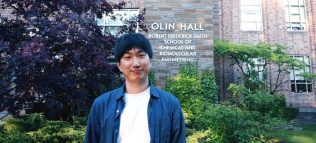
The first recipient of the Coalition’s newly renamed Pamela Delp Polashenski M.D. Breast Cancer Research Trainee Grant, Sangwoo Park hails from South Korea. Currently a Ph.D. candidate at Cornell University, he kindly agreed to meet and discuss his Coalition-funded study, “Overcoming the glycocalyx barrier to engineered cellular therapeutics.”
Pat: Thank you for taking the time to share your work with our survivor community. What originally motivated you to study breast cancer?
Sangwoo: As you know, I came from South Korea, where I served in the military as a firefighter for a few years. I was dispatched to many different accidents including fires and car crashes as a firefighter or Emergency Medical Technician. I still clearly remember the day when the person I was assisting had stage IV lung cancer, and while transporting the patient to the university hospital, there was nothing I could do for him other than supply oxygen or measure the blood pressure. At that point, I wanted to do something for cancer patients. Because my major was in physics, I wanted to help them with my physics background.
After I finished my military service, I went back to college in South Korea and joined the lab to study cancer research. I studied breast cancer and lung cancer. We developed a device that diagnoses breast cancer and lung cancer with a small blood sample. But I wanted to learn more about cancer biology and new techniques to find cancer treatment. That’s why I applied to the Cornell Biophysics program; to learn about cancer and to help cancer patients.
Pat: How would you describe your project that the Coalition is funding?
Sangwoo: Immune cells such as natural killer cells – NK cells – are our frontline guardians of the immune system. They can find the pathogens, viruses, and cancer cells, and kill them. But the results of immunotherapy in treating breast cancer have not been universal and remain unsatisfying. One of the recent immunotherapies is called the immune checkpoint blockade. That blocks immune suppressors and enhances immune activity against cancer cells. But only about 25% of patients across all indications respond to immune checkpoint blockade therapy. So a better understanding of the mechanisms of tumor inhibition may help.
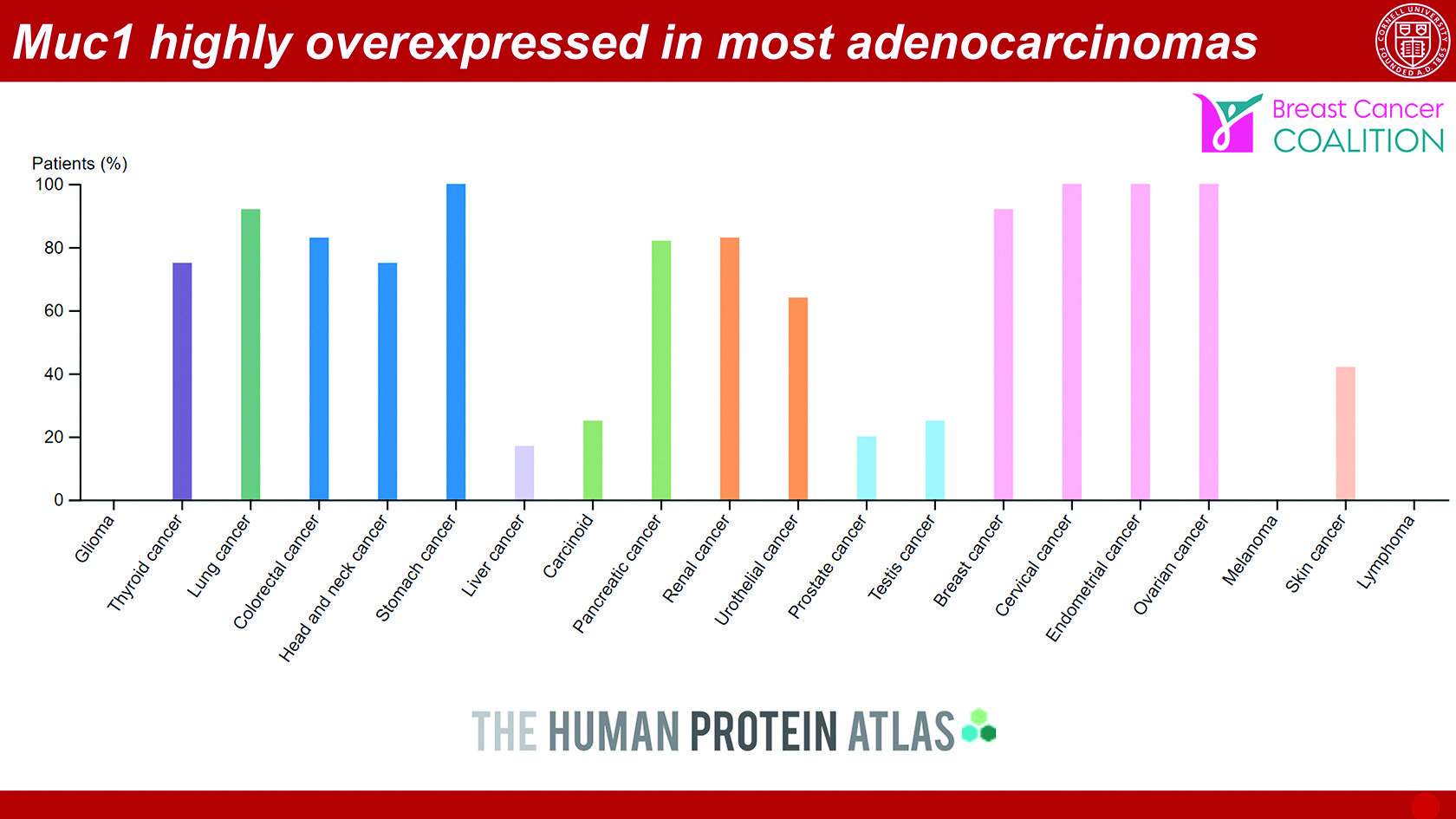
We think one of these evasion mechanisms may involve the cancer cell glycocalyx acting as a barrier to immune cell engagement. Glycocalyx literally means sugar (glycol) and husk (calyx). One of the main components of this glycocalyx is called mucins. Cancer cells are often associated with dramatic overexpression of cell surface mucins, and they cause a thick glycocalyx structure. For example, Mucin 1 (Muc-1) is one of the membrane proteins belonging to mucins and is overexpressed in over 90% of breast cancers.
The physical length of this Muc-1 is usually 100-200 nanometers (nm: one-hundred-millionth of a meter). But immune cells such as NK cell need close cellular contact for immune recognition because the size of the immune receptor is only 30nm. So, Muc-1 is likely to act as a barrier to immune cell engagement with cancer cells.
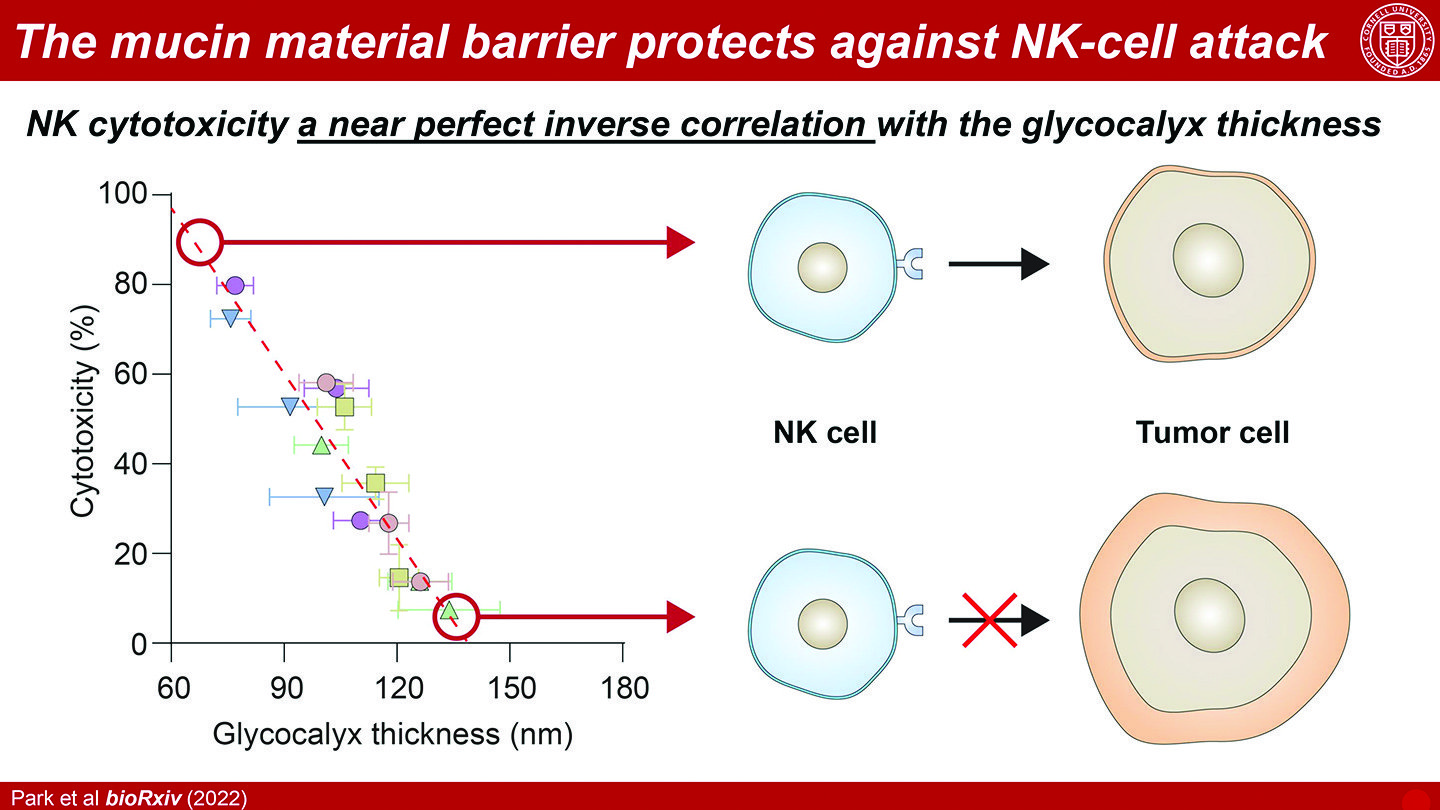
We think the mucin-infused glycocalyx does something for immune engagement. We found that tiny changes in the glycocalyx thickness – as small as 10 nanometers – could affect the anti-tumor activity of the NK cells. Thus, new strategies to disrupt or penetrate the glycocalyx barrier are needed for improved cancer immunotherapy. We will develop strategies to engineer immune cells with new capabilities to breach the glycocalyx barrier and more effectively kill breast cancer cells. One of the strategies is equipping NK cells with enzymatic machinery that can chew away the cancer cell glycocalyx. And the other strategy is equipping NK cells with engineered receptors that can penetrate the glycocalyx and functionally link immune cells to targeted cancer cells.

Pat: Is the potential role of the glycocalyx in protecting cancer cells from detection by the immune system a recent discovery?
Sangwoo: The importance of the glycocalyx for immune response is a recent discovery. One reason we haven’t known about the biophysical role of the glycocalyx is because we couldn’t measure its thickness precisely before. But in our study, we were able to measure this thickness with a custom-developed microscope. It’s called Scanning Angle Interference Microscopy – SAIM – and with that approach, we can actually measure the glycocalyx thickness, reading in nanoscale resolution.
We have used genetic engineering techniques to create cell lines with different thicknesses of glycocalyx. By combining genetic engineering techniques with SAIM, we were able to understand the biophysical properties of the glycocalyx in these engineered cell lines. And then we measured how many engineered cells were killed by NK cell attack. Here, we found that tiny changes in thickness of the glycocalyx as small as 10 nanometers could affect NK cell response.
Pat: Is one of your aims, then, to enable the body’s natural defenses to recognize cancer cells after the thickness of the glycocalyx has been reduced?
Sangwoo: Yes, one of our aims is to reduce the thickness of only the cancer cell glycocalyx to help the body’s natural immune system.
As we discussed, the glycocalyx thickness is a main factor in immune engagement. Immune cells will recognize cancer cells and kill them more easily after reducing the cancer glycocalyx thickness.
StcE mucinase is one of the enzymes that can digest mucins. We can tether this anti-mucin enzyme, or mucinase, to the NK cell. By anchoring mucin-specific enzymes on the engineered NK cell, we found that most of mucin-expressing tumor cells were killed by engineered NK cells.
Pat: Are you doing this work on cells in petri dishes or in animals?
Sangwoo: We use cancer cell lines. Our NK engineering technique has been verified in petri dishes and we are planning to do animal studies with our technique in the near future.
The glycocalyx is a complex structure like a forest. A forest is full of different types of trees. Just like thinning trees in a forest, we will reduce the glycocalyx thickness by using different enzymes that can cut different mucins like trees.
Thus, my first aim is to make a universal platform that can capture different enzymes on NK cells and I hope these engine sets can then kill the cancer cells efficiently.
Pat: You’re approaching the glycocalyx from different angles, chemically speaking, and intend to attack it on as many fronts as you can.
Sangwoo: Yes. What we’re saying is, ‘What if the structure of the glycocalyx is very important in developing immunotherapy?’ That’s a new way of looking at immunotherapy.
And the next aim is chimeric antigen receptor (CAR) engineering. CAR-T or CAR-NK therapy has been one of the most powerful immunotherapy techniques. Basically, CAR structures that target specific cancers, such as breast or lung cancer, can be anchored on immune cells to enhance immune activity. However, we showed that the thicker glycocalyx structure blocks CAR-T cell recognition and the efficacy of this treatment. So we thought, ‘What if we make the CAR structure longer so it can penetrate the glycocalyx more easily?’ That’s another idea we’re working on in this project.
Pat: Would you say your goals are a better understanding of how to deal with the presence of the thickened glycocalyx, either by thinning it or using existing immunotherapy approaches that have been engineered to penetrate through that thickness?
Sangwoo: Immunotherapy targeting the biophysical properties of the glycocalyx has not yet been developed. Our goal is to develop better cancer immunotherapy by using our recent finding that glycocalyx structure is a major determinant of cellular resistance to immune cell attack.
The Breast Cancer Coalition’s support will get us a step closer to developing new immunotherapies that are highly specific and potentially able to cure breast cancer. Again, I’m very grateful for the Coalition’s support of my proposed work.
Pat: We’re very happy to provide that support. As you know, the goals of our Research initiative are to address primary prevention of breast cancer, preventing it from metastasizing, halt progression and/or obtain regression should it metastasize, and ultimately, cure of the disease.
Sangwoo: To achieve the goal of curing breast cancer, animal studies must first be performed to optimize NK engineering techniques and to determine whether the proposed work will be effective in animals or humans. The Coalition’s support is very meaningful to me. As I explained earlier, I was hopeless at the time when I first witnessed cancer patients. However, as a scientist, I am so happy that there is something I can do for cancer patients with the new immuno-engineering technique.
Pat: You didn’t get stuck feeling hopeless. Instead, you used that feeling to develop something that gives you, and all of us, hope. We’re grateful to you for the work you do and look forward to following your progress.
Sangwoo: Thank you very much for your kind words. I will do my best, and I really appreciate the Coalition’s support.
This story appeared in the Autumn 2022 newsletter, Voices of the Ribbon.